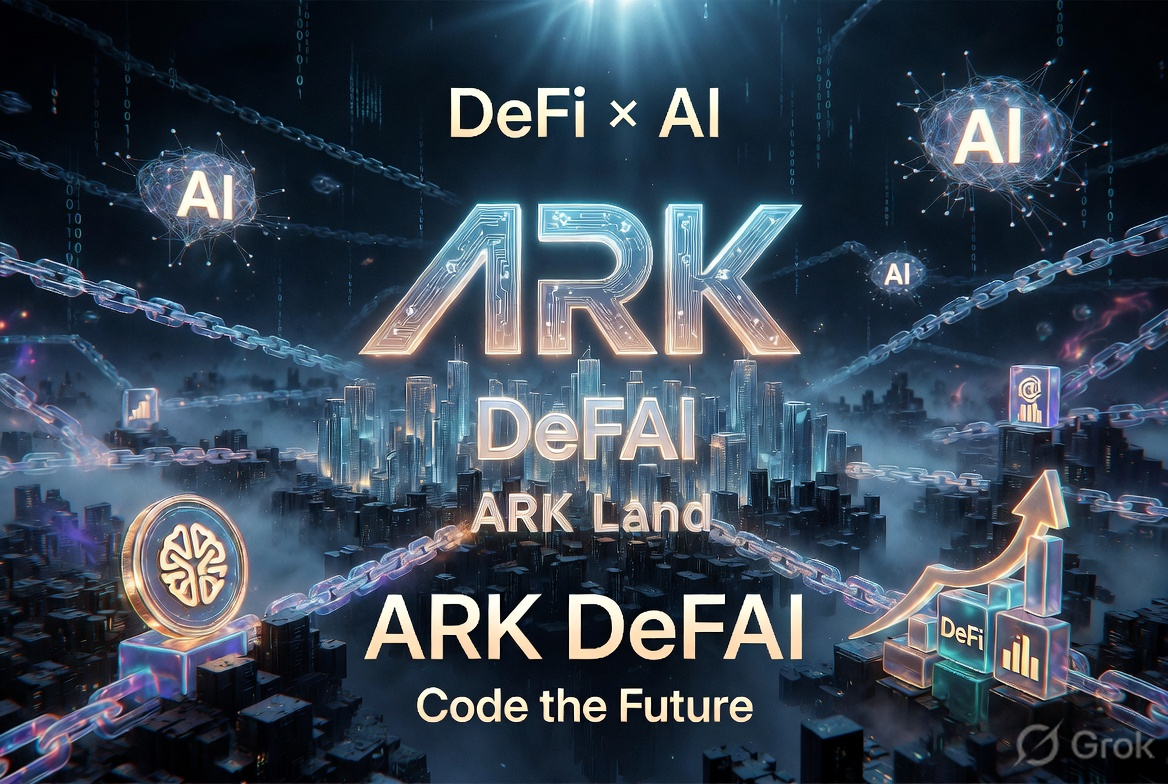
ARK DeFi Cryptocurrency: Complete 2026 Guide to ARK DeFAI AI-Powered DeFi Protocol
Explore ARK DeFi (ARK DeFAI) cryptocurrency in this in-depth guide. Learn about its AI-driven governance, modular DeFi architecture, tokenomics, ARK Loan, ARK Land digital nation, and why it’s pioneering the next era of decentralized finance. Price, features, roadmap & investment insights.
ARK DeFi Cryptocurrency: The AI-Powered Future of Decentralized Finance and Digital Civilization
In the rapidly evolving world of cryptocurrency, few projects stand out as boldly as ARK DeFi. Often referred to as ARK DeFAI (Decentralized Finance × Artificial Intelligence), this innovative protocol is not just another DeFi token—it’s a visionary attempt to build a self-sustaining, AI-governed digital nation on the blockchain. Launched on the BNB Smart Chain (BSC) with its mainnet going live in August 2025, ARK DeFAI combines programmable monetary modules, DAO consensus, and advanced AI algorithms to create a transparent, stable, and scalable on-chain economy that operates beyond traditional human discretion.
As of early 2026, the ARK token trades around $16 USD, with a market cap in the tens of millions and strong 24-hour trading volumes exceeding $5 million. But numbers alone don’t capture its ambition: ARK DeFi cryptocurrency aims to redefine governance, finance, and community participation in Web3. In this comprehensive 1500+ word guide, we’ll dive deep into what ARK DeFAI is, how it works, its unique features, token utility, roadmap, risks, and why it could be a game-changer for investors and users seeking the next evolution in DeFi. Whether you’re a crypto enthusiast, DeFi trader, or curious about AI-blockchain convergence, this SEO-optimized breakdown covers everything.
What Is ARK DeFi Cryptocurrency?
ARK DeFAI is a next-generation DeFi protocol designed as a “protocol civilization”—a modular economic system governed entirely by intelligent algorithms and DAO consensus rather than centralized teams or majority human votes. At its core, it merges DeFi primitives (lending, liquidity, yield) with AI-driven decision-making to create a self-regulating digital economy.
Unlike traditional DeFi platforms that rely on human governance (which can lead to delays, conflicts, or centralization risks), ARK positions itself as the world’s first human-governance-free financial experiment. Its philosophy: “When humans are no longer trustworthy, models become the new governors.” The protocol uses open-source code, smart contracts, and AI models (such as LSTM forecasters, reinforcement learning optimizers, and risk oracles) to propose, simulate, and execute policies autonomously.
Built on BSC for speed and low fees, ARK DeFAI’s native token is ARK (contract: 0xcae117ca6bc8a341d2e7207f30e180f0e5618b9d). It powers everything from governance voting to economic flywheels. The project frames users not as mere holders or liquidity providers, but as “digital citizens” in an evolving on-chain nation called ARK Land.
This DeFi x AI fusion addresses key pain points in crypto: volatility, unsustainable emissions, poor governance, and lack of long-term stability. By integrating AI for predictive forecasting, scenario simulation, and real-time adjustments, ARK DeFi cryptocurrency seeks to build a fairer, more resilient financial system powered by logic, data, and code.
The Vision: From On-Chain Economy to Intelligent Digital Nation
ARK DeFAI’s founders envision more than yield farming or token trading. They see the protocol as the prototype for a “decentralized intelligence framework”—a civilization simulator where AI and community consensus replace institutional control.
The narrative shift is explicit:
- From institutional rule → Algorithmic governance
- From on-chain economy → Intelligent digital nation
- From technical assembly → Rewriting ideology through computation
This isn’t hype; it’s embedded in the architecture. ARK Land, the project’s digital city layer, includes a Model Marketplace (for AI financial tools, advisors, and agents), NFT Governance Identities (combining Proof-of-Stake and Proof-of-Impact), Builder DAO for creators, and Citizen Task Centers for rewarded contributions. Future expansions could include social apps, digital art, and collaborative creation—turning ARK into a full metaverse-like ecosystem for economic and social coordination.
In an era where DeFi TVL fluctuates wildly and DAOs often suffer from low participation, ARK’s AI-augmented model promises neutrality, speed, and scalability. It’s a bold bet on the convergence of AI, blockchain, and decentralized coordination.
Core Technology: Modular Architecture Meets AI-Driven Intelligence
What sets ARK DeFi apart is its composable, upgradeable modular design. The protocol consists of five core regulatory modules and two financial backing systems, all orchestrated by an AI Consensus Layer.
The five command modules include:
- EM (Emission Manager): Dynamically controls token issuance based on treasury health and market conditions.
- RBS (Range Bound Stability): Algorithmically stabilizes price ranges to reduce extreme volatility.
- YRF (Yield Revenue Feedback): Uses protocol revenues for token buybacks and burns, creating deflationary pressure.
- MCL (Minting Cap Limit): Sets intelligent caps on new token minting tied to reserves.
- RCM (Runway Control Module): Monitors long-term sustainability and adjusts reward paces.
Supporting these are:
- POL (Protocol-Owned Liquidity): Builds self-owned liquidity pools for stability.
- ATS (ARK Treasury System): Manages collateral; interest and fees flow back to strengthen the treasury.
The AI Consensus Layer is the brain: It features three tiers—human governance (proposals and votes by citizens), AI Advisory (predictive models like LSTM/Prophet for forecasting and RL optimizers for policy simulation), and Autonomous Execution (smart contracts that implement AI recommendations daily). This creates a self-auditing, self-proposing, self-executing loop that minimizes human bias and maximizes data-driven efficiency.
These modules form an interconnected economic flywheel: emissions adjust → users bond → liquidity builds → yields generate revenue → burns and stabilization occur → treasury strengthens. The result? A more sustainable DeFi system less prone to rug pulls or death spirals.
How ARK DeFAI Works: The Economic Flywheel in Action
ARK DeFi cryptocurrency operates through a closed-loop system designed for self-sustainability. Users interact via bonding, staking, lending, or governance. Protocol revenues (from fees, yields, loans) feed the ATS treasury, which triggers YRF burns and EM adjustments via AI.
For example, the ARK Loan system introduces decentralized lending where the “floor price” serves as the sole credit metric—creating a stable, governance-oriented borrowing mechanism without traditional collateral volatility issues. Interest and fees recycle into the treasury, powering the flywheel.
AI agents simulate scenarios in real-time: If market sentiment shifts (via Sentiment Scanner), the RBS module might tighten ranges, while the Decision Engine optimizes emissions. This automation makes ARK faster and more adaptive than human-led DAOs.
Governance and DAO: AI as Neutral Advisor
Traditional DAOs suffer from voter apathy and whale dominance. ARK DAO flips this with a dual-core system: citizens propose/vote on models and issues, while AI acts as a neutral advisor analyzing data, running simulations, and recommending optimal paths. Execution happens autonomously via smart contracts—no manual delays.
NFT Governance Identities add reputation (PoI) to staking power (PoS), rewarding active contributors. The long-term goal is AI federation, where multiple models collaborate across chains for universal governance.
ARK Land: Your Digital Nation Experience
ARK Land transforms the protocol into an interactive ecosystem. Citizens access:
- Model Marketplace for AI-powered tools (wealth managers, leverage assistants).
- Builder DAO for developers to create and monetize models.
- Task Center for earning rewards through contributions.
- Future social and creative features.
This turns passive holders into active citizens in a thriving digital society.
Tokenomics and ARK Token Utility
While exact allocations aren’t fully public in all docs, the ARK token (total supply around 25M, with dynamic circulating figures) derives value from:
- Governance voting and bonding.
- Economic flywheel participation (emissions, burns via YRF).
- Staking for rewards and NFT identities.
- Utility in ARK Loan, liquidity provision, and ARK Land interactions.
Deflationary mechanics (YRF burns, MCL caps) and treasury backing aim for long-term value accrual. As adoption grows, demand for ARK could rise through governance fees, model usage, and ecosystem expansion.
Roadmap: From Genesis to Global Civilization (2025–2035)
ARK’s ambitious roadmap spans phases:
- 2025–2026 (Seed Project): Core modules deployed, mainnet live, initial governance.
- 2027–2028 (Intelligent Construction): Module upgrades, AI enhancements, multi-language support.
- 2029–2030 (Chain Nation Genesis): Full identity systems, virtual cities, sovereign nodes.
- 2031–2035 (Civilization Upgrade): AI federation, self-evolution, global governance frameworks.
This decade-long vision positions ARK DeFAI as infrastructure for the future of decentralized coordination.
How to Buy, Store, and Use ARK DeFi Cryptocurrency
Buying ARK is straightforward:
- Use a CEX like Binance, Bitget, or XT.COM for direct fiat-to-ARK or USDT pairs.
- On DEX (recommended for DeFi-native users): Connect a BSC-compatible wallet (MetaMask, Trust Wallet) to PancakeSwap, swap BNB/USDT for ARK using the contract address.
- Store securely in a non-custodial wallet supporting BSC.
- Engage: Stake for governance, bond for flywheel participation, lend via ARK Loan, or explore ARK Land.
Always DYOR, use hardware wallets for large holdings, and verify contracts to avoid scams.
Advantages, Risks, and Comparisons
Advantages:
- AI neutrality reduces governance failures.
- Modular design for upgradability and resilience.
- Sustainable economics via flywheel and burns.
- Unique “digital citizen” experience beyond typical DeFi.
- Early-mover advantage in DeFAI narrative as AI adoption surges.
Risks:
- High volatility (crypto standard; ATH ~$41 in late 2025).
- Complexity: New users may find AI modules intimidating.
- Regulatory uncertainty around AI-DeFi hybrids.
- Smart contract risks (though audited; check CertiK ratings).
- Competition from established DeFi giants like Aave or emerging AI protocols.
Compared to projects like traditional DeFi (Uniswap) or pure AI agents, ARK uniquely blends both with civilization-scale ambition—positioning it as more than a protocol, but a foundational layer for on-chain societies.
Conclusion: Is ARK DeFi the Future of Crypto?
ARK DeFi cryptocurrency represents a paradigm shift: from human-centric finance to algorithmically governed, self-sustaining digital economies. With its modular DeFi engine, AI consensus, ARK Loan innovation, and ARK Land vision, it offers a compelling case for long-term holders and builders in the Web3 space.
As blockchain and AI converge in 2026 and beyond, protocols like ARK DeFAI could capture significant value. However, crypto is high-risk—invest only what you can afford to lose, conduct thorough research, and monitor developments via official channels (arkdefai.com, Gitbook docs).
Ready to join the ARK civilization? The future isn’t controlled by human governance—it evolves through code. Code the future with ARK DeFi today.